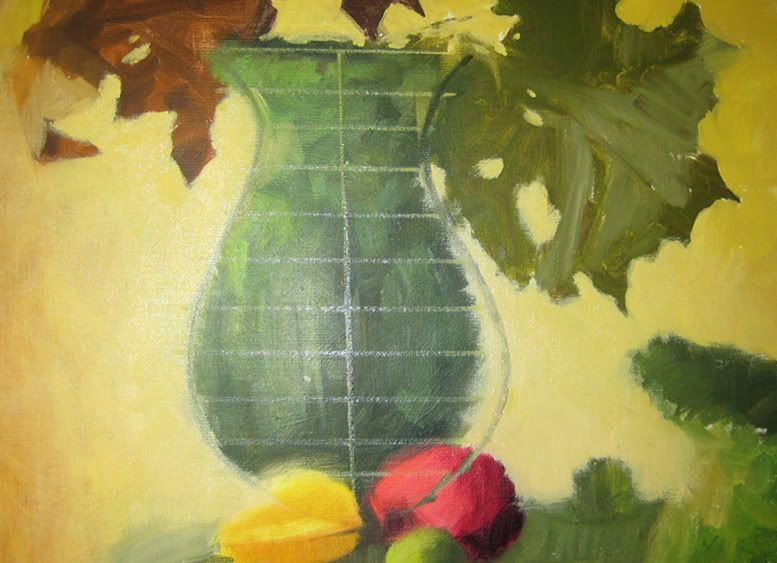
Here I go again, ruining a perfectly nice painting with all sorts of sloppy drawing. When you look at the photo , take care to note that I painted the background and the cloth OVER my previous painting of the pitcher and onion. Then I re-drew the contour of the pitcher and the onion.
This does look so very messy, and it is hard to make myself do it. But again, just as in the vase I did the other day, this bit of painting the background into a shape, and then drawing the shape back over, is my way of keeping the edges dynamic, the drawing accurate, the paint quality expressive and the illusion of depth.
Whenever I used to hear about Dynamic Edges, I got an image of some sort of superhero battling a razor blade. "Watch your edges." "Be careful of your edges." Those sorts of admonitions meant nothing to me, and I was too embarrassed to ask what an edge was.
Just in case you, too, are clueless and embarrassed, here's what an edge is: it's the place in the painting where one color leaves off and another begins. When we learned to color in a coloring book, we were told to stay in the lines, and from that point on we thought perfection meant having a nice, clean edge. We could cut clean edges when we painted the trim around our windows. We could really stay in the lines when we drew our design and painted it in on our canvas.
But... Dynamic edges? Well here's the thing: real life doesn't have sharp edges. Nearly everything you paint will have some sort of gradual transition from one color to the next. A lemon on a red cloth will be just ever so slightly blurry -- a little bit out of focus. This is called a soft edge. An apple on a red cloth may even just plain blend into the cloth. This is called a lost edge.
In your painting, you want to have a variety of edges: some hard, some soft, some lost. When you have that kind of variety, you have achieved the great goal of Dynamic Edges. This is the way our brain processes light impulses, so if you paint with this in mind your paintings will be more believable.
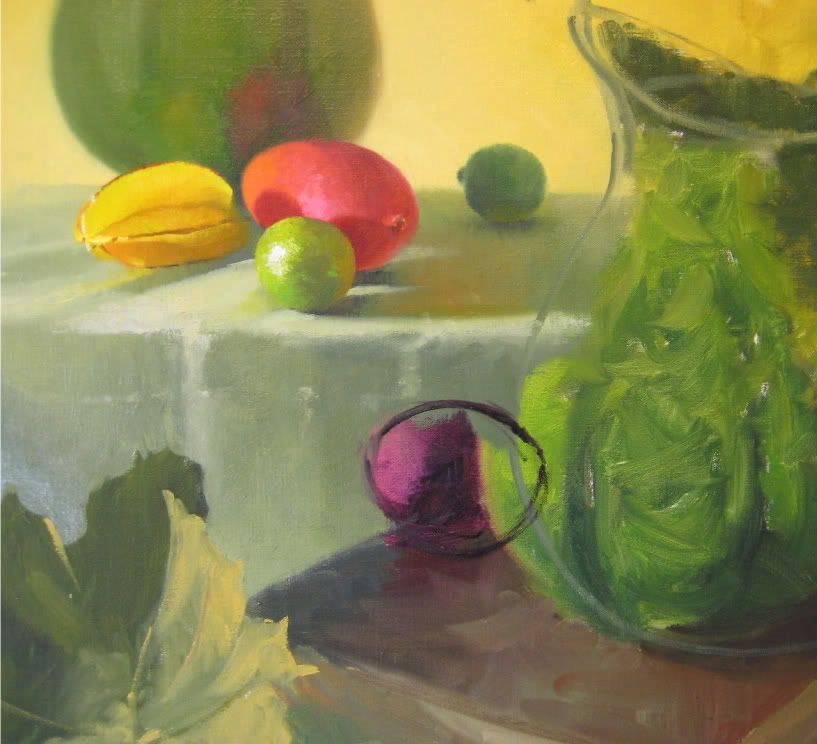
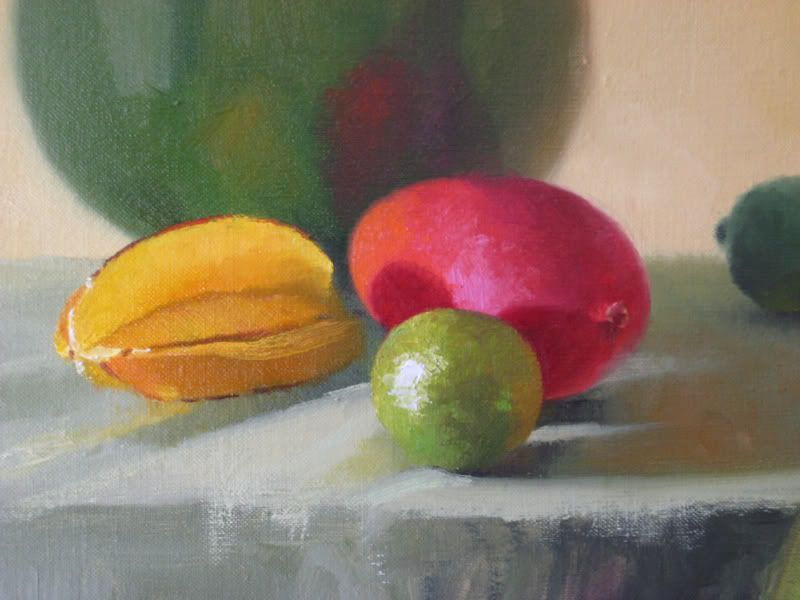
As I developed my focal point, I made sure to vary the edges. You will see some obviously soft edges along the vase, and some obviously hard ones in the fruit. But observe more carefully and you'll find that each piece of fruit has some hard, some soft and some lost edges. Take a look:
After two days of teaching, I'm ready to get back to the easel! Last session was fun: I had solved my problems of composition and theme, and quickly got the basic idea onto the canvas.
Now it's time for the weird part: the "structured drawing" and "painting through."
Both of them look like I've ruined my painting! It's almost mortifying to even post this picture at this stage. Lots of artists, in fact, skip this stage. Some people don't even know about it, but even when you DO know about this step, it's really hard to make yourself do it.
You can see in the picture that I have painted some of the background color back OVER the vase and fruit, and furthermore I have drawn lines on the vase and even drawn some of those lines over the fruit. This is not because I can't control my brush and accidentally got paint all over the vase and the fruit. This counter-intuitive mess is crucial to achieve the illusion of light, depth and form that I want to get in the painting. You see, to make the vase look like it's curving back into the background, I need to put background color into the edges of the vase. And in order to get the shape of the vase to look three-dimensional, I need to "draw through" the fruit.
Tomorrow I'll post a picture of the result. It'll look good. Trust me, I'm a ... an artist.
The light this morning is soft and cool. It strikes an assortment of large leaves I had collected last fall. I pick one of them up; it's perforated. The holes are the same size as those in the ceramic.
These are not tropical leaves. These are large, exotic-looking but deciduous. They have dried into tattered, windblown, dramatic shapes.
Hm. Fixing them into the vase, placing a collection of luscious tropical fruit at the focal point, I muse about the contrast in colors and shapes and a theme begins to emerge. God's creation is larger than just the season of one country. Winter and summer are going on all at once in this world.
Experience is greater than that of one person. As one mourns, another rejoices.
Once I've solved the problems of composition and theme, the first rough lay-in of paint takes only a few hours.
I got to my studio today to find that a fire had broken out in Glen Leven, the historic mansion where my plein-air painting group had planned to meet this weekend. The living quarters in the back of the house were damaged, but the rest of the place will be all right. Thank Heaven for that! The news stations made it sound like the place had burned to the ground. Grr!!
Much of my work time was distracted by that, but the main reason I didn't get any painting done today (and I didn't, and here is the excuse) was that none of the florists in town are carrying Monstera leaves this week! In fact, they really aren't carrying tropical greens or flowers at all. They're involved in forcing branches just now. How can I be so totally out of step? Honestly.
So here are some creative possibilities: forget my perforated-leaf and perforated-vase theme; forget my tropical theme; paint this picture when the leaves come in, and paint something else for now; go to the botanic garden and do drawings of tropical leaves and use those. Why not just use photos of tropical leaves? Because I need to have a mental understanding of how light falls on the structure of the leaves. Once I get that, I could refer back to photos. But for the painting to look real, I must actually study the real leaves.
Which of these options will I choose? I don't even know just now. In the morning, with the light on my vases again, I will have a better feel for it. You know... we do try to be businesslike and professional, but sometimes we artists just need to feel the light.
Music and art seem to go together pretty well... as long as you've chosen the right music. I tend to get so wrapped up in whatever the musicians are doing, that my own project can take a left turn. This can work to my benefit if I'm painting a bright abstract and listening to Metallica.
I'm currently listening to a Pandora station which features artists like Hans Zimmer (Dark Knight and Sherlock Holmes) and Apocalyptica. VERY intense! So, I'm stretching a canvas today. Just mindless work, right? Should be able to listen to whatever I like.
Until, half an hour later, I find the staples have gotten away from me and are marching across the stretcher bar in close formation, the canvas is so tight it's pulling the bars together, and the Joker has outwitted Batman AGAIN.
Sometimes silence is, indeed, golden. .
Ok yeah I know where babies come from. But where do baby ideas come from? I've decided to document the inception and development of an idea, starting with something I really want to paint.
I have these wonderful vases and pitcher -- that's a closeup of one of them over there on the right -- and I want to paint them.. So here I am trying to come up with an idea that will do them justice.
See the little holes in the vase? Those got me to thinking about tropical leaves. (the fact that we are having yet another snowstorm also has me thinking about tropical leaves, but that's another story) The kind of leaves I am thinking of are those big ones with the holes in them, just like the vase.
Ransacking Google Images, I found the leaf: it's called Monstera. Wow, that could get my imagination going a whole different direction! So, holes in the vase, holes in the leaf, tropical dreaming....monsters... not sure where this will go, but you'll know when I do!